New Rules Give USCIS More Authority to Deny Green Cards for Anticipated Use of Public Benefits
On July 20, 2026, USCIS published new regulations that greatly expand its discretion to deny applications for permanent residence based on a determination that the applicant is likely to need to claim means-tested public benefits in the future. USCIS had published similar regulations in 2019, during President Trump’s first term, but the Biden Administration abandoned those regulations and ultimately implemented a mildened version of those regulations in 2022. Since the new regulations and explanations of them cover over 154 pages of the Federal Register, I will summarize just the most important changes and place them into perspective.
New Totality of the Circumstances Test
For the last 30 years, since Congress last tightened the public charge requirement in 1996, USCIS’s determination of whether an applicant was likely to become a “public charge”, i.e., someone who is being supported by the government and U.S. taxpayers, by extension, was limited to examining whether the immigrant’s petitioner and financial sponsor earns sufficient income, or has sufficient assets in lieu of sufficient income, to support the immigrant. Where the petitioner and financial sponsor does not earn enough income or have enough assets, an immigrant could have a financial co-sponsor. As long as the financial sponsor or co-sponsor could show enough income and/or assets, then USCIS would generally approve, since they had to restrict their consideration to the information presented in the I-864 or I-864A forms and the supporting evidence.
USCIS has implemented a new "Totality of the Circumstances Test", which views the I-864 and I-864A forms and the supporting evidence as just one factor for consideration. In addition, they are considering a multitude of other factors, including, but not limited to, the following:
- The immigrant’s age;
- The immigrant’s health, i.e., whether the immigrant has chronic health conditions that could interfere with his or her ability to work and earn income to support himself or herself and could necessitate long-term care at public expense (this will likely result in more questions being raised in the cases of elderly parents of U.S. citizens, particularly those with severe chronic health conditions or in the cases of special needs children who are wholly dependent on their parents for life);
- The immigrant’s household size and whether there is sufficient income in the present and the past, or sufficient financial assets and resources, to support the immigrant and the members of the immigrant’s household;
- The immigrant’s past history of work and being financially self-supporting;
- The immigrant’s qualifications such as education, vocational training, job skills from past employment, any specialized skills that are in demand in the job market, and fluency in English;
- Whether the immigrant has ever applied for, been approved for, or actually received “means-tested public benefits” after September 18, 2026, even if the immigrant was eligible for the benefits at the time, for instance, based on having had pending applications or approved applications for refugee, asylum, T, U, Uniting for Ukraine, Violence Against Women Act, or other statuses that allow for receipt of public benefits, but then subsequently apply for adjustment of status on another basis such as family relations, to receive the benefits;
- Whether the immigrant has ever applied for, been approved for, or actually received “means-tested public benefits” for the benefit of his or her child(-ren) after September 18, 2026, since the immigrant’s income must have to have been low enough to qualify for means-tested benefits for the child(-ren) and the immigrant chose to apply; and
- Whether, after September 18, 2026, the immigrant has ever applied for, been approved for, or actually received from USCIS a filing fee waiver based on having a low income.
USCIS pointed out, on the one hand, that, in the totality of circumstances test, it would not consider the U.S. citizen petitioner’s past receipt of means-tested public benefits. On the other hand, if the U.S. citizen petitioner is still receiving means-tested public benefits and some of those benefits could go to support the immigrant beneficiary financially, then that would support a finding that the immigrant will become a public charge.
It is also interesting to note that, in the latest version of the I-864 affidavit of support form, the financial sponsor or co-sponsor signing the I-864 form grants USCIS permission to perform a credit check on the person in order to evaluate whether the financial sponsor/co-sponsor has a good credit score and track record of repaying loans and debts and, based on that, whether he or she has a would be a reliable source of financial support and financial sponsor for the immigrant.
New Definition of Means-Tested Public Benefits
First of all, a “means-tested public benefit” means a public benefit that is obtained (whether for the applicant’s own direct benefit or for the benefit of the applicant’s U.S. citizen child) by the applicant proving that he or she has very low income and typically minimal or no assets. The first Trump administration attempted, in 2019, to broaden the definition of what means-test public benefits would be considered, but the Biden Administration directed USCIS to narrow the definition to include only cash benefits such as (1) two federal cash assistance programs (Supplemental Security Income (SSI) and Temporary Assistance to Needy Families (TANF); (2) state/local general assistance; or (3) long-term institutionalization at government expense (a special Medicaid program). It expressly excluded SNAP, most Medicaid, CHIP, WIC, and housing assistance from consideration, since they were not cash benefits.
Under the second Trump Administration’s direction, USCIS greatly broadened the definition of what qualifies as a “means-tested public benefit”. In fact, USCIS refused to specify which programs would be considered in favor of leaving it to the USCIS officer to determine whether a given benefit falls within the definition of a means-tested public benefit. Moreover, the new definition of means-tested public benefits includes cash and non-cash public benefits. Cash benefits are those that are paid directly to the recipient, whereas non-cash benefits are those that are paid to third parties for the benefit of the recipient.
What if USCIS determines that the immigrant beneficiary is likely to become a public charge?
If the USCIS examiner reaches the conclusion that the immigrant beneficiary will likely become a public charge, needing means-tested public benefits, what happens then? The USCIS examiner can deny the adjustment of status or other application pursuant to INA Section 212(a)(4). This presents the usual options in the case of a denial:
1.Refile the application with more convincing evidence to convince USCIS to reach a different decision the second time;
2.File a motion to reopen or reconsider the decision.
3.Request that USCIS grant the option to post a “Public Charge Bond”, which would serve as a guarantee that the immigrant beneficiary will not apply for and receive means-tested public benefits.
The Public Charge Bond is a concept that goes back to 1903, but it has fallen out of use. However, USCIS and the Department of State are once again offering this option.
If USCIS determines that an adjustment applicant is inadmissible due to being at high risk of becoming a public charge, but is otherwise admissible, the agency may grant the application if the applicant posts a bond. Before the applicant may post a public charge bond on Form I-945, however, they must be invited by the USCIS officer to do so. This invitation follows USCIS’s issuance of a formal Notice of Intent to Deny (NOID) in connection with the I-485 application.
The officer has broad discretion in determining when to exercise this option as well as the amount of any bond. The USCIS Policy Manual provides officers with a framework for setting bond amounts and addressing the maintenance, breach, and cancellation of bonds, based on amended 8 CFR § 103.6(c). The regulation establishes a minimum bond amount of $1,000, but USCIS has discretion to require a substantially higher amount based on the circumstances of the case. The stronger the likelihood that the applicant will become a public charge and the amount of public benefits they are likely to receive, the higher the bond amount. Note that the DOS has piloted its own immigrant visa public charge bond program at select consular posts, which operates under separate authority and procedures. Those bonds are reportedly reaching well into six figures for some applicants.
The bond will be cancelled, and the amount returned upon any of the following events: after five years have elapsed without breach; naturalization; death; permanent departure; or replacement by an approved substitute bond. For bonds posted on or after September 18, 2026, receipt of any means-tested public benefit by the bonded immigrant before cancelation constitutes a breach.
Whom does this rule change impact?
The following table from USCIS’s website specifies which categories of immigrants and visa holders are impacted by the change in the public charge rules and which are not.
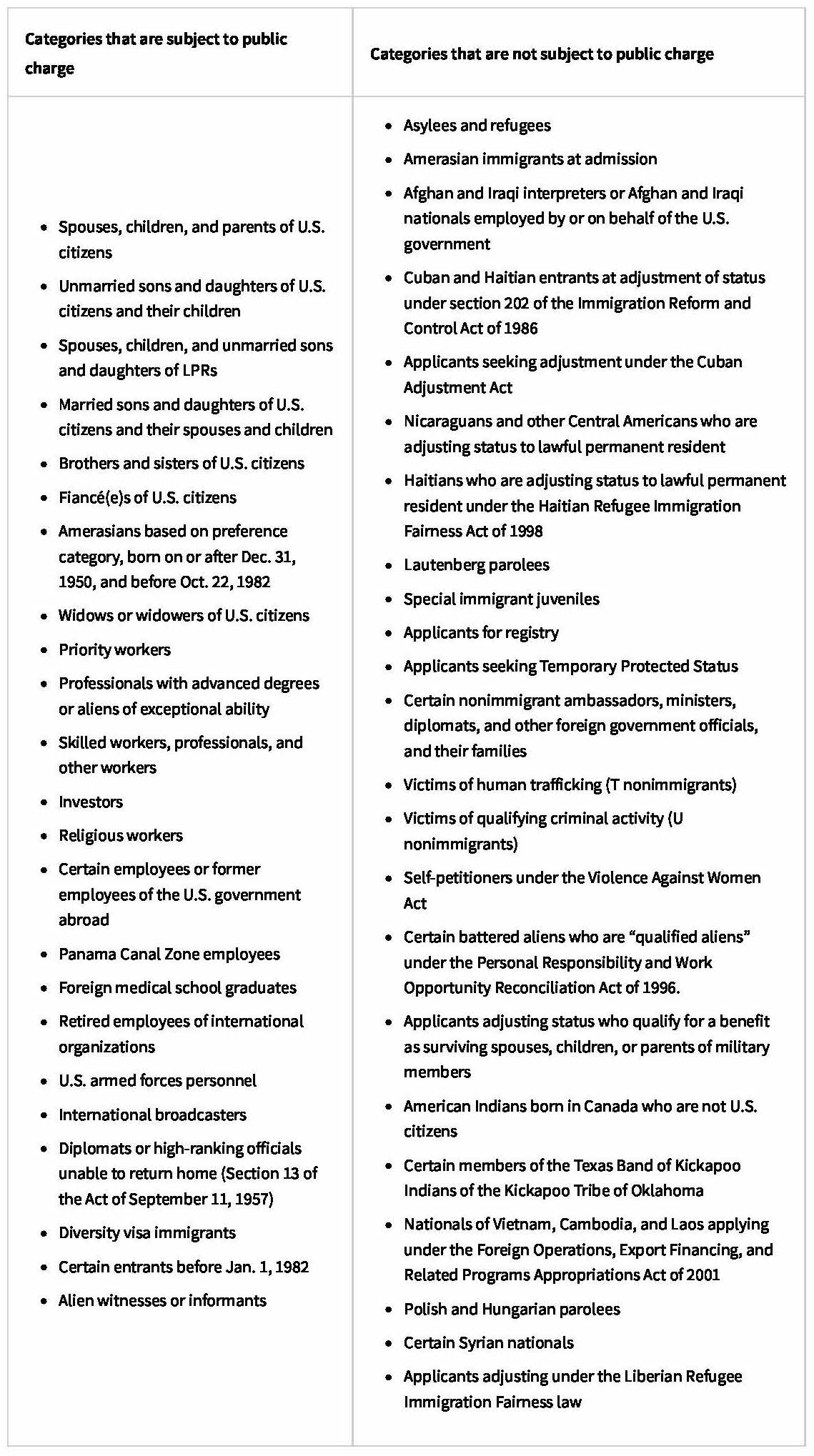
Although immigrants in the employment-based immigration categories can be challenged by USCIS and the Department of State (DOS) to prove that they will not become public charges, they very seldom require the immigrant to prove that they will not become a public charge, since they are immigrating to the U.S. in order to take on a specific job, which has a pay level well above the poverty level. Similarly, EB-5 investors are typically bringing a substantial amount of capital with them beyond the amount that they have invested in an enterprise that will create jobs for U.S. workers, and so USCIS and DOS are generally not questioning them on how they will support themselves in the U.S.
Congress had good reason to impose on petitioners in family-based immigration cases the requirement to submit an affidavit of support, while not imposing such a requirement in the employment-based context (except where a relative owns the employer-petitioner business). I would say that most immigrants with whom I have spoken and dealt over the years are not the least bit interested in receiving government benefits and, in fact, have an aversion to accepting such benefits, viewing them as handouts or charity. There are, nevertheless, some immigrants, who just like their counterparts in the native-born U.S. citizen population, who will grab for anything of value that they can get for free. In fact, multiple times, intending immigrants have come to me for consultations, where the person had come to the U.S., given birth to a U.S. citizen baby, claimed poverty, and let the U.S. government pay for the childbirth, and then they wanted guidance on how to immigrate successfully now that their 21-year-old U.S. citizen child could petition for them, but they were concerned about possible obstacles and consequences from having stuck the U.S. government with paying for the childbirth. Until now, there have been no consequences for such a shameless form of birth tourism. Also, there has been lax enforcement of the affidavits of support by state and federal agencies when immigrants have obtained public benefits. Affidavits of support have been used more often by immigrants during and after divorce proceedings to force their ex-spouse to contribute to the immigrant’s financial support at a level at least 25% above the poverty level.
In short, this day of reckoning has been coming for some time, with U.S. taxpayers already angry about native-born U.S. citizens working the welfare system, they find it particularly galling that immigrants are getting away with it, too. The family-based immigration categories are among the largest sources of immigrants seeking public benefits. Ironically, asylum-seekers, another major source, are not subject to the public charge ground of inadmissibility and so they are free to accept means-tested public benefits (but, as mentioned above, if they switch to applying for permanent residence in a category that is subject to the public charge ground of inadmissibility, they will be held to account for receipt of means-tested public benefits in the new process.)
What can we expect from USCIS and DOS in their decision-making pursuant to the new public charge rules?
USCIS is still updating its training materials such as the Policy Manual and DOS is updating the Foreign Affairs Manual to reflect the changes in the public charge rules, and both agencies are retraining their staff on what the Totality of the Circumstances Test is and how to apply it in each case. However, the rules themselves, USCIS’s explanations in the Federal Register publication of the new rules, and past guidance on this topic from USCIS during the first Trump administration tell us what USCIS and DOS will be looking for. We will be making the case that our clients will be upstanding and contributing members of society and proving this based on their track record in the U.S. and abroad, that they are financially self-supporting, that they have useful skills and abilities to offer the U.S., and, if they have any chronic health issues, that they have them under control and so they will not be needing support from the U.S. government.
There is bound to be federal court litigation if USCIS and DOS overreach while claiming to be just enforcing Congress’ intent. Often, Federal Court judges often interpret congressional intent, constitutionality, and due process differently than the Trump Administration does, and so immigration attorneys are winning far more cases than they are losing in Federal Courts as they challenge the Trump Administration’s policies that are either at odds with existing laws and/or are improperly implemented. Therefore, USCIS and DOS do not have unlimited discretion to enforce their new policies if they break the law, violate the Constitution, deny due process, or are at odds with congressional intent.
If you would like our assistance in navigating the complicated landscape created by these new public charge rules and other obstacles that the Trump Administration keeps putting up, please feel free to call us at (941) 362-7100 to schedule a consultation.